Data-Driven Marketing In 2026: Personalization Or Privacy, Navigating The Data Maze Without Losing Your Mind
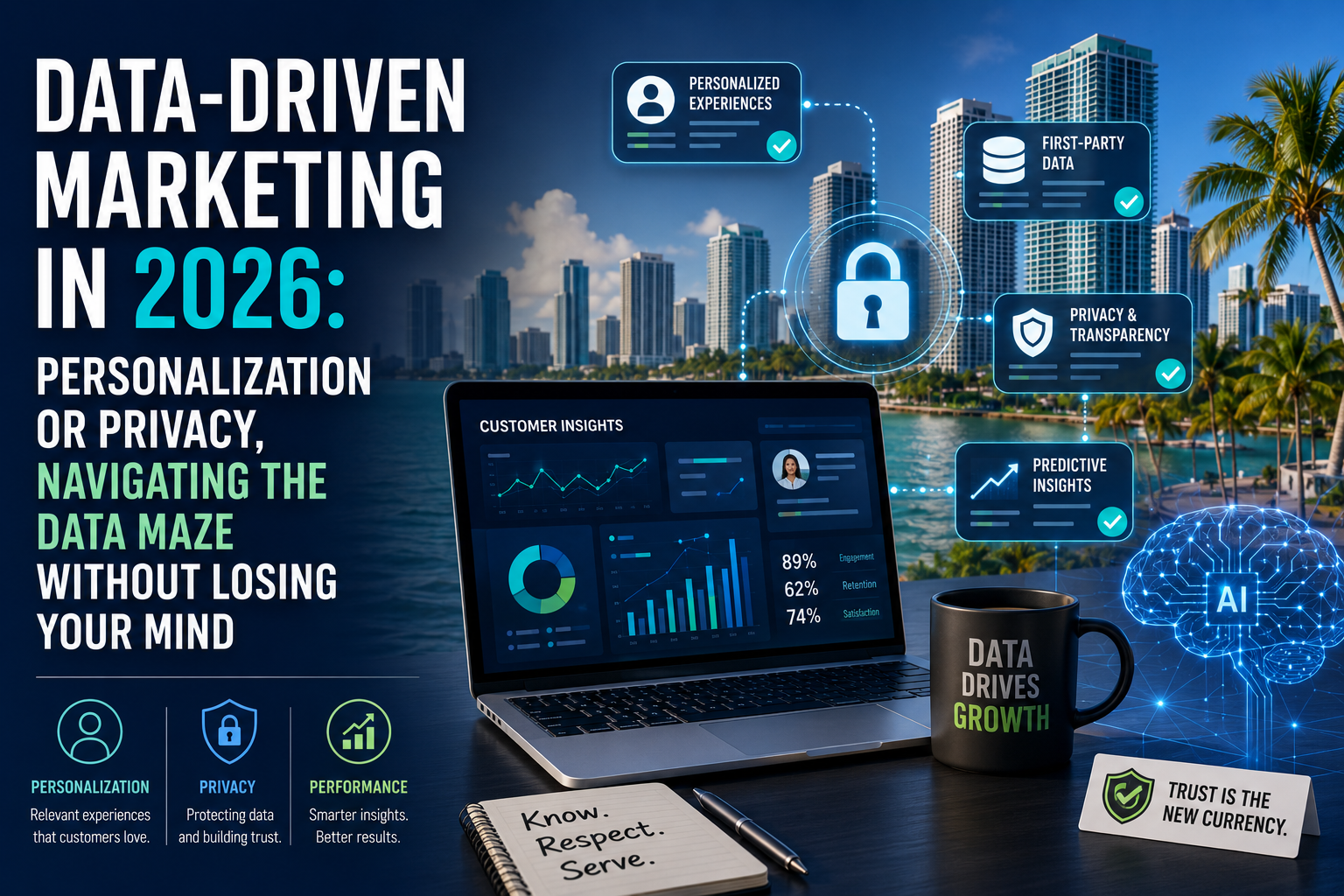
The digital landscape of 2026 has reached a fascinating and somewhat paradoxical crossroads. On one hand, consumers have never been more demanding of personalized experiences; they expect brands to know their preferences, anticipate their needs, and provide relevant solutions in real-time. On the other hand, global concerns regarding digital footprints and surveillance have led to a revolutionary shift in how information is collected, stored, and managed.
For brands in South Florida and beyond, the challenge is no longer just about gathering as much information as possible, it is about a sophisticated Data-Driven Marketing strategy that respects the delicate balance between high-level personalization and absolute customer privacy. Navigating this "data maze" requires more than just technical tools; it requires a mindset shift that values transparency as much as it values conversion.
The Evolution of Personalization in a Privacy-First World
The era of unrestricted third-party tracking, the "Wild West" of digital marketing, has officially come to a close. As major browsers and mobile operating systems have tightened security and phased out cookies, the old methods of "following" a user across the web have been replaced by more ethical, direct approaches. Today, successful marketing isn't about "spying" on a customer; it’s about building an opt-in relationship where the customer chooses to share their details because they see the value in the exchange.
In 2026, Marketing personalization has evolved from being perceived as "creepy" to being perceived as "helpful." Instead of seeing an ad for a product you just mentioned in a private conversation, consumers are now met with tailored experiences based on their actual, verified interactions with a brand. This shift has forced companies to rethink their digital architecture, ensuring that every touchpoint, from social media to your Miami web design, is optimized to gather and utilize data responsibly.
First-Party Data Strategies: The New Gold Standard
With the death of the third-party cookie, First-party data strategies have emerged as the most valuable asset in any marketer’s toolkit. First-party data is information that you own and collect directly from your audience through your own channels. This includes email sign-ups, purchase history, loyalty program interactions, and direct feedback.
The beauty of first-party data is its accuracy and compliance. Because the user has consented to provide this information to you directly, the risk of violating Customer privacy is significantly reduced. To build a robust first-party database in 2026, brands are getting more creative than ever by offering interactive content like quizzes and "style finders" that help define a user’s needs while providing them immediate value.
Navigating the Legal and Ethical Landscape
Privacy is no longer just a "best practice" or a tagline; it is a legal mandate. With the expansion of regulations like GDPR and various state-level privacy acts in the U.S., brands must be hyper-vigilant about how they handle consumer information. However, rather than seeing these laws as a hurdle, the most successful Miami advertising agency strategies view them as an opportunity to build trust.
When a brand is transparent about what data it collects and why it is being collected, customer loyalty actually increases. Research shows that 2026 consumers are significantly more likely to shop with a brand that clearly outlines its privacy policy in plain, human language rather than hiding it in a wall of complex "legalese." Ethical data usage is now a core component of brand identity.
Integrating Data Across the Full Marketing Stack
The biggest mistake a brand can make in the "data maze" is keeping their information in silos. To be truly data-driven, your insights must flow through every department. If a customer interacts with an ad on Instagram, that preference should be reflected when they visit your website or receive a follow-up email. This requires a "Single Source of Truth", a centralized data platform that updates in real-time.
Data should serve the creative process, not replace it. By understanding the data, we can craft messages that resonate on a deeper, more human level. Whether you are adjusting your local search strategy or refining your brand voice, data provides the "why" behind every creative "what." When your digital ecosystem is healthy, you can get in touch with us to refine how those insights are converted into actual sales.
The Psychological Shift: From Surveillance to Service
The modern consumer is tech-savvy and highly aware of their digital worth. They know their data has value, and they are tired of being treated like a "target" in a database. The brands that are winning in 2026 are those that have shifted their perspective from "surveillance marketing" to "service marketing."
Data-driven service means using information to reduce friction. If you know a customer usually buys a specific product every 30 days, a well-timed, personalized reminder isn't an intrusion, it's a helpful service. If your website can remember a user's size or preferred shipping method, you are saving them time. This level of intentionality is what keeps a brand relevant in an increasingly crowded and noisy digital marketplace.
Predicting the Future: AI and Predictive Analytics
We cannot talk about Data-Driven Marketing in 2026 without mentioning Artificial Intelligence. Predictive analytics has moved beyond basic forecasting. We can now model future consumer behavior with incredible accuracy, allowing brands to optimize their inventory, their ad spend, and their content calendars months in advance.
However, the "AI paradox" remains: the more automated our marketing becomes, the more the "human touch" matters. Data tells you what people are doing, but it takes human intuition and empathy to understand why they are doing it. The most successful strategies of the future will be those that use AI to handle the heavy data lifting while leaving the emotional storytelling and relationship-building to people.
Conclusion: Privacy is the New Personalization
As we look toward the remainder of 2026 and beyond, it is clear that personalization and privacy are not opposing forces. In fact, they are two sides of the same coin. You cannot have meaningful, long-term personalization without the foundation of trust that comes from respected privacy.
The "data maze" is only confusing if you try to take shortcuts or hide your intentions from your audience. By focusing on high-quality first-party data, maintaining total transparency, and using insights to provide genuine service, your brand can rise above the noise. In a world of infinite choices, the most personalized thing a brand can do is show its customers that their data, and their trust, is in safe hands.
Frequently Asked Questions
How can I start a first-party data strategy if I currently rely on ads?
Start by identifying "value-exchange" points on your own website. This could be a newsletter, a downloadable guide, or a loyalty program. The goal is to give the user a compelling reason to identify themselves to you directly.
Does focusing on privacy mean my ads will be less effective?
Actually, the opposite is often true. While your target audience size might appear smaller on paper, the quality and intent of that audience are much higher. People who have opted-in to your brand are far more likely to convert.
What is the most important "data point" to track in 2026?
While every business is different, "Customer Lifetime Value" (CLV) is often the most telling metric. It moves the focus away from a single, isolated transaction and looks at the long-term health of your customer relationships.
How does web design impact data collection and privacy?
Your website is your primary data collection tool. Proper design ensures that consent banners are clear, forms are easy to navigate, and the technical infrastructure is in place to track behavior accurately without violating modern privacy standards.
Is AI-driven marketing safe for small to mid-sized businesses?
Yes, as long as you are using reputable, established tools that prioritize data security and encryption. Many AI platforms now offer "privacy-safe" modeling that allows you to gain deep insights from your data without ever compromising individual user identities.
