Miami Local SEO Map: How to Rank Where Your Customers Actually Live
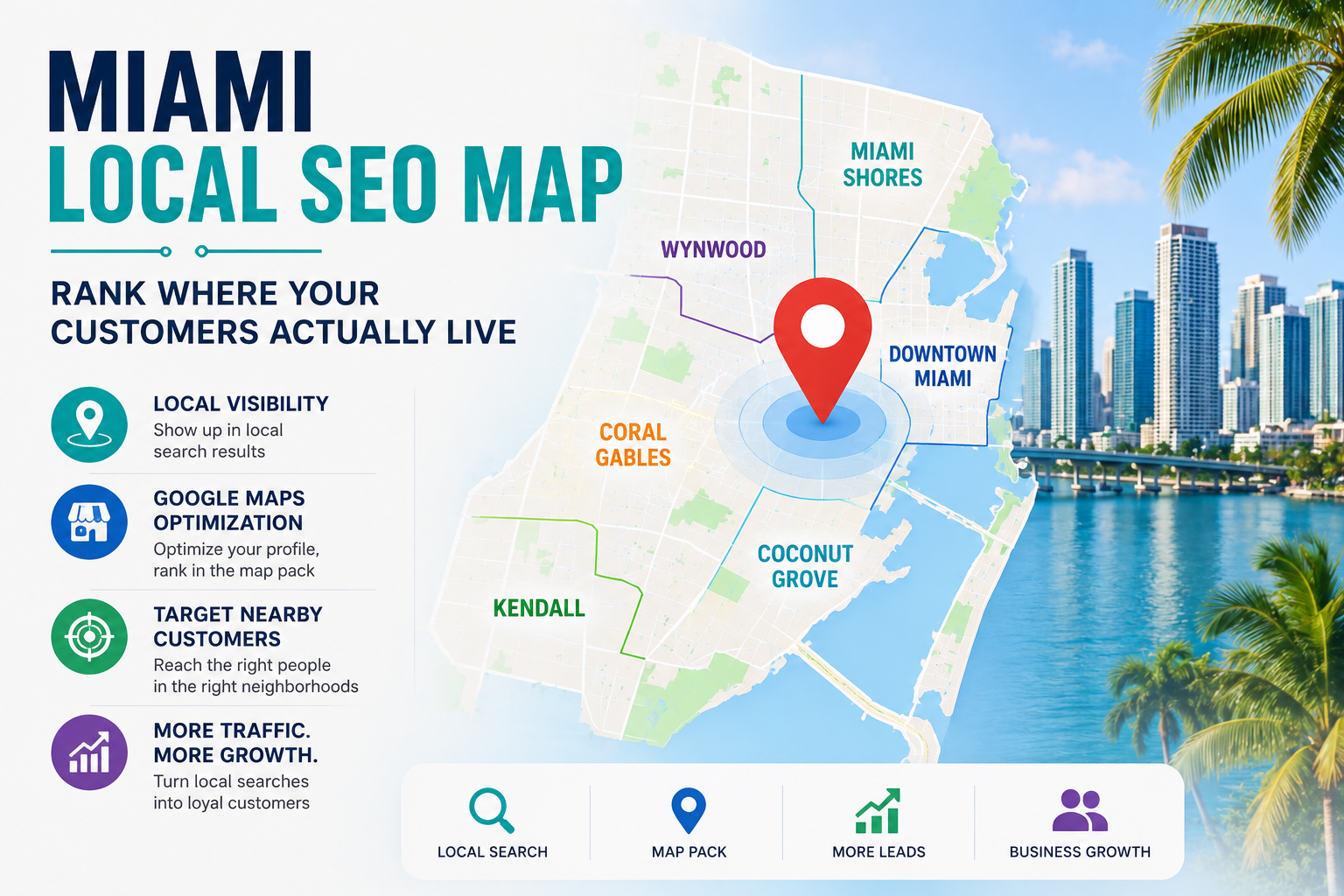
Miami is a city of neighborhoods. From the corporate high-rises of Brickell to the artistic streets of Wynwood and the suburban sprawl of Kendall, where your customers live dictates how they search. For a business owner, simply ranking for "Miami" isn't enough anymore. The real growth happens when you dominate the specific blocks where your target audience spends their time.
In 2026, local search has evolved into a high-stakes game of proximity and intent. It is no longer just about having a functioning website; it is about visibility in the exact millisecond a customer pulls out their phone to solve a problem. This guide explores how to master Miami Local SEO to ensure your business shows up exactly where it matters most.
The Shift to Hyper-Local Search
The days of broad keyword targeting are fading fast. Google’s algorithms are increasingly focused on the "hyper-local" experience. When someone in Coral Gables searches for a service, they see a completely different set of results than someone in Aventura or Hialeah. This "neighborhood-first" logic is the foundation of modern Miami search engine optimization.
To win in this environment, your digital presence must reflect the geography of South Florida. This means creating content that mentions specific landmarks, neighborhood culture, and local events. By signaling to search engines that you are a fixture in the local community, you increase your chances of appearing in the "Map Pack", the three local business listings that appear at the top of Google search results. Without this visibility, you are essentially invisible to the 46% of all Google searches that have local intent.
Google Maps Optimization: Your Digital Storefront
For most local businesses, your Google Business Profile (GBP) is actually more important than your homepage. Google Maps optimization is the meticulous process of ensuring this profile is complete, accurate, and highly active.
- NAP Consistency: Your Name, Address, and Phone number must be identical across every platform, from your website to Yelp and industry-specific directories. Even a small discrepancy, like "St." vs "Street," can confuse search engines and hurt your rankings.
- Hyper-Local Reviews: Encourage customers to mention their neighborhood or the specific service provided in their reviews. A review that says, "Best AC repair in Pinecrest," carries significantly more weight for local rankings than a generic "Great job."
- Local Image Tagging: When uploading photos of your business or projects, ensure they are geotagged to Miami coordinates. This provides further proof to Google of your physical location and service area.
- Attribute Management: Make sure to select all relevant attributes for your business, such as "locally owned," "outdoor seating," or "appointment required," as these often trigger results for specific filtered searches.
Geo-Fencing Marketing: Finding Customers on the Move
While SEO helps customers find you, geo-fencing marketing allows you to find them. This technology creates a virtual boundary around a specific geographic area, like a competitor’s location, a popular shopping center, or a local stadium like the Hard Rock.
When a potential customer enters that "fence" with their mobile device, they can be served targeted ads for your business. In a competitive market like Miami, this is a powerful tool for South Florida business growth. For example, a luxury realtor in Miami Beach could geo-fence high-end restaurants in the area to reach potential buyers exactly when they are soaking in the local lifestyle. This precision ensures that your marketing dollars are spent only on people who are physically in the position to visit or engage with your brand.
Integrating Social Media with Local SEO
Local search doesn't happen in a vacuum. Often, a customer discovers a brand on Instagram or TikTok before searching for their location on Google. This is why working with a Miami social media agency is a vital part of a holistic SEO strategy.
Social signals, like check-ins, local tags, and engagement from users within the Miami area, help validate your business’s relevance to the region. When your social media activity and SEO strategy are aligned, you create a "surround sound" effect. If a user sees your ad on Instagram while in Wynwood and later searches for your service on Google, your consistent local presence across both platforms builds the trust necessary to convert them into a customer.
The Importance of Neighborhood-Specific Landing Pages
If your business serves multiple areas, say, Doral, Miami Lakes, and Weston, you cannot rely on a single "Contact Us" page. To rank where your customers live, you need dedicated landing pages for each major neighborhood.
These pages should not be "copy-paste" versions of each other. Each page must feature localized content, such as:
- Testimonials from clients in that specific neighborhood.
- Photos of work completed in that area.
- Directions from local landmarks.
- Localized keywords that residents actually use (e.g., "The Gables" vs "Coral Gables").
This strategy is a core component of how Heyday Marketing approaches market dominance. It signals to Google that you aren't just a "Miami business," but a specialist in each community you serve.
Building a Strategy for South Florida Business Growth
The Miami market is unique because it is both a local hub and a global destination. A successful strategy must balance these two worlds. You need to rank for the tourist looking for "best boutique hotels in Miami," but you also need to own the search for the local resident looking for "reliable plumber near me."
Achieving this requires constant monitoring. Local SEO is not a "set it and forget it" task. Rankings fluctuate based on:
- New Competitors: New businesses opening their doors and claiming their profiles.
- Algorithm Updates: Changes in how Google weighs proximity vs. prominence.
- Consumer Behavior: Shifts in how people move through the city (e.g., the rise of new hubs like Midtown or Edgewater).
Technical SEO for the Mobile Miami User
Miami is a mobile-first city. Whether people are stuck in Palmetto traffic or walking down Lincoln Road, they are searching on their phones. If your website takes more than three seconds to load, you’ve lost the customer.
Technical SEO factors like site speed, mobile responsiveness, and "Click-to-Call" buttons are essential. If a user finds you on a map but your website doesn't load or the phone number isn't clickable, the SEO effort was wasted. Ensuring your site is technically sound is the baseline for any serious growth strategy.
Signs Your Business Needs a Local SEO Tune-Up
It may be time to rethink your strategy if:
- You rank for your business name but not for your core services (e.g., you show up for "Smith & Co" but not "Miami Law Firm").
- Your competitors are appearing in the Google Map Pack, but you are buried on page two.
- You are getting traffic to your site, but it is coming from outside of Florida.
- Your Google Business Profile has unanswered questions, outdated hours, or poor-quality photos.
Final Thoughts
Ranking where your customers live requires a blend of technical precision and local intuition. By focusing on Miami Local SEO, optimizing for Google Maps, and utilizing advanced tools like geo-fencing, you can turn the map of South Florida into a roadmap for your business’s success.
The competition in Miami isn't slowing down, and neither should your digital strategy. If you are ready to stop being invisible in your own neighborhood and start dominating the local map, it is time to get in touch with us. Let's discuss a customized ranking strategy that targets the residents who are ready to buy today.
Frequently Asked Questions
How long does it take to see results from Miami Local SEO?
While technical fixes to your Google Business Profile can show results in as little as 30 days, a comprehensive strategy that involves content creation and backlink building typically takes 3 to 6 months to achieve top-tier Map Pack rankings.
Is Google Maps optimization different from regular SEO?
Yes. While regular SEO focuses on website authority and global keywords, Google Maps optimization is driven by "The Three Pillars": Proximity (how close you are to the searcher), Prominence (how well-known your business is), and Relevance (how well your business matches the search intent).
What is the benefit of geo-fencing for a South Florida business?
Geo-fencing allows for hyper-efficient ad spending. Instead of targeting all of Miami-Dade, you can target people within a one-mile radius of your store or even people attending a specific event at the Miami Beach Convention Center.
Do reviews really affect my local ranking?
Absolutely. Google uses reviews as a primary signal for "Prominence." Not only does a high volume of positive reviews help you rank higher, but reviews containing keywords (like "best seafood in Miami") also help you show up for those specific searches.
How do I choose the best keywords for Miami Local SEO?
Focus on "Service + Location" combinations. However, don't just use "Miami." Use the neighborhoods where your highest-value customers live, such as "Wealth management Brickell" or "Luxury car detailing Kendall." Analyzing the local competition's "hidden" keywords is also a vital step in our process.
